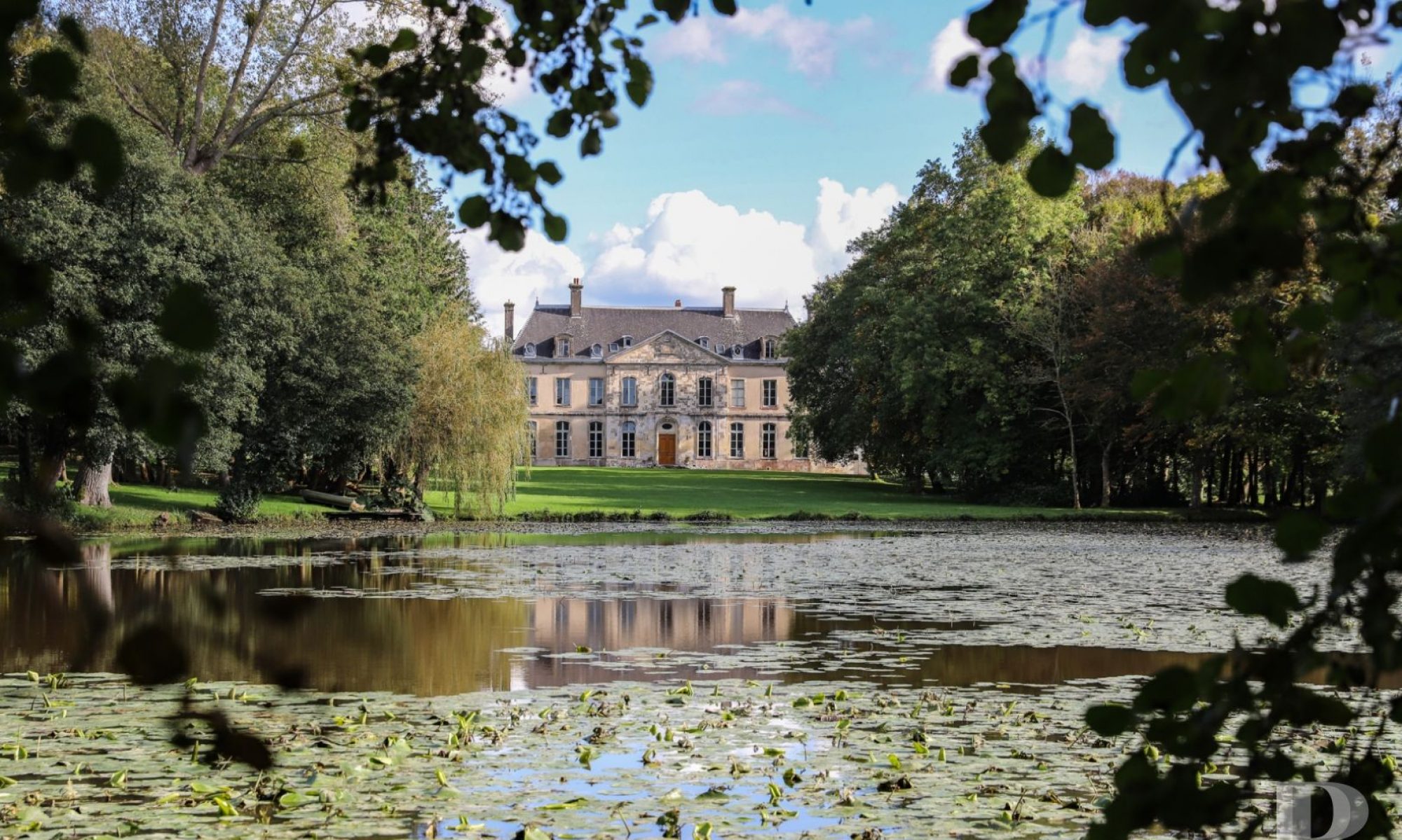
Richard de la Haye, seigneur de la Haye-du-Puits and Varenguebec and 2nd Baron of Shipbrook, established the Abbey of Blanchelande in 1154. He was scion of the de la Haye family who had risen to prominence after 1042 when William the Bastard emerged victorious following the battle of Val es Dunes.
Richard de la Haye has a most interesting history. He was escaping from Geoffrey Plantagenet, Count of Anjou, when he had the ill luck to fall in with some Moorish pirates by whom he was captured and kept as a slave for some years. He however succeeded in regaining his liberty, and after his return to France, he and his wife, Mathilde de Vernon, founded the abbey of Blanchelande in 1154. Some sources say the couple founded the abbey in thanks.
In 1157 Henry II King of England confirmed by charter the property of the abbey of Blanchelande, including donations by “Engelgerius de Bohon…Ricardus Avenel…Doon Bardouf et Thomas frater eius…”.
In a charter issued by Richard de Bohon (priest of Coutances, 1151-1179), Richard confirms the donation of the church of Ste-Marie of Cheteville (Cretteville) with the approval of Richard de la Haye to the Abbey of Blanchelande in 1157.
On 4/2/1175 at Valognes, Robert Marmion attested a charter of the King in favor of Blanchelande abbey. (S) CH&I,HII.
Blanchelande abbey was part of the Premonstratensian order of canons, founded by St Norbert in 1119 at Prémontré, near Laon, in north-eastern France. Quickly approved by the Papacy, the order rapidly spread throughout Europe. They operated a stricter and purer form of the rule of St Augustine, supplemented with ideas drawn from the Cistercians. It was a life of tremendous austerity, abstinence, fasting and mortification, all dedicated to the contemplation of God.

The name Blanchelande (‘whiteland’) is thought to be from the white habits of the canons.
The Norbertines arrived in England about 1143, first at Newhouse in Lincoln, England; before the dissolution under Henry VIII there were 35 houses.[2] Soon after their arrival in England, they founded Dryburgh Abbey in the Borders area of Scotland, which was followed by other communities at Whithorn Priory, Dercongal Abbey and Tongland Abbey all in the Borders area, as well as Fearn Abbey in the northern part of the nation. Like most orders they were almost completely devastated by the successive onslaughts of the Reformation, French Revolution and Napoleon, but then experienced a revival in the 19th century.
Blanchelande was a powerful abbey with close ties to England. The historical Cammeringham Priory in Lincolnshire founded by Richard de Haye about 1160 as an alien cell to the Abbey of Blanchelande in Normandy and also to the abbey of L’Essay in the diocese of Coutances. A dispute arose between the two abbeys, which was settled in favour of Blanchelande in 1192, by William Bishop of Coutances. Blanchelande also owned a priory in Guernsey, after which the present-day Blanchelande College is named. The Priory of Martin-vast in Jerbourgh was also a dependency of the abbey of Blanchelande.
In France the title of Moulin de Biard with Pont D’Ouve was gifted to Blanchelande by Humphrey de Bohon.
The full name of the abbey is Abbaye Notre-Dame et Saint-Nicolas de Blanchelande.